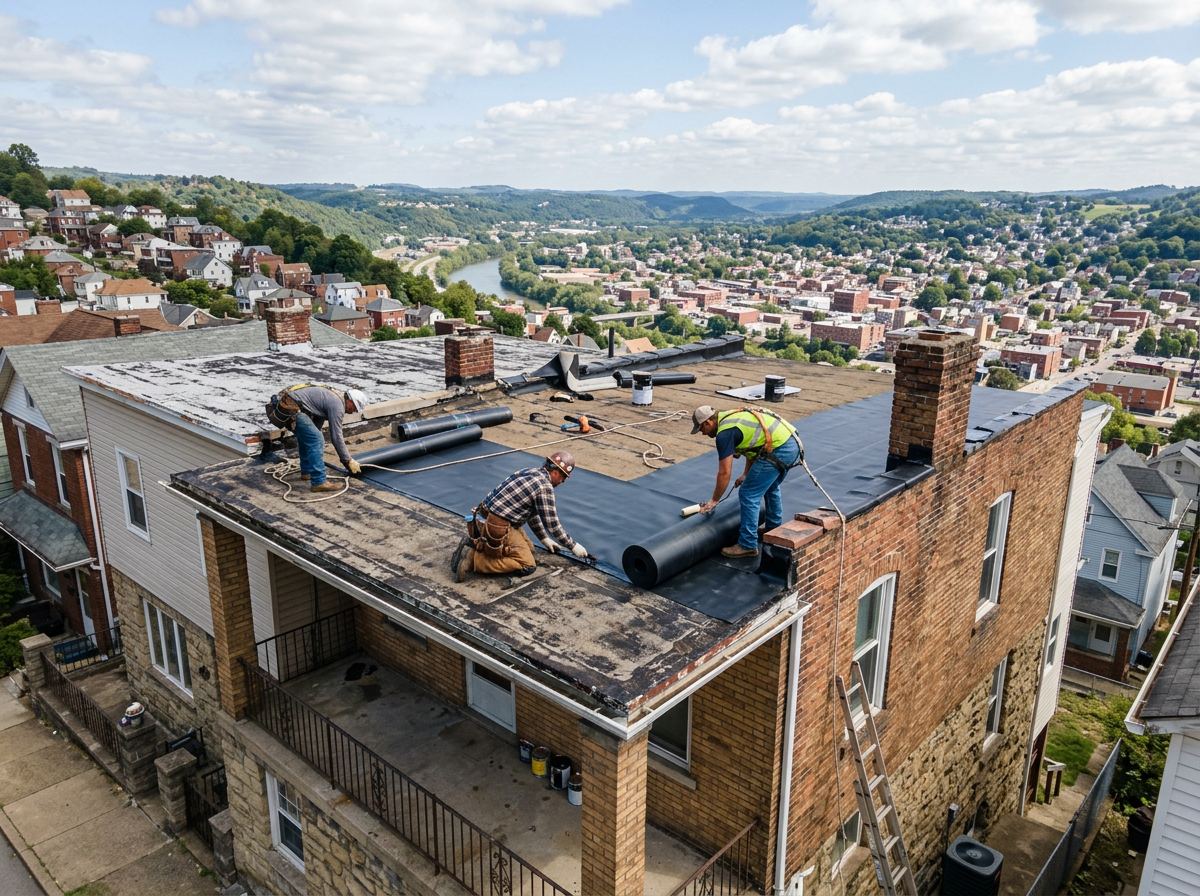
Flat roofs on porches and additions in Johnstown often fail from standing water after heavy snowmelt, ice dams that form at eaves during freeze-thaw cycles, and wind-driven rain that penetrates seams on ridge-top homes. Older steel-mill-era homes in neighborhoods like Moxham, Kernville, and Westmont frequently have plank decking that sags under repeated snow loads, while additions in Richland Township and Geistown see granule loss and seam separation from summer hail and thunderstorms. Our crews inspect by lifting existing layers to check for wet insulation, rotted plank decking, and inadequate slope that traps water against brick chimneys and walls.
We begin every flat roof project by documenting drainage patterns around the Conemaugh River valley and noting how tight hillside access in places like Cambria City or along PA-271 affects material staging. Preparation includes removing all existing membrane and underlayment down to the deck, replacing damaged sections with new OSB where plank boards have shifted, and installing new drip edge plus ice and water shield at valleys and perimeters. Installation follows with fully adhered EPDM or torch-down modified bitumen, sealed step flashing at adjoining walls, and new pipe boots to restore a watertight surface that withstands strong ridge winds.
Local conditions in the Laurel Highlands demand balanced ventilation and proper counter-flashing around chimneys common on early-1900s homes in Hornerstown and Roxbury. Our crews pay special attention to transitions where flat sections meet steep-pitch slate or shingle roofs, ensuring no gaps that allow ice dam leaks into living spaces below. Work on these compact lots requires careful protection of narrow streets and neighboring properties while maintaining attic ventilation balance to reduce future condensation issues.
Technician insight
In Johnstown, the thing that catches most people out with flat roof replacement is hidden rot on plank decking under multiple old layers on steep hillside additions; the tight access in neighborhoods like Cambria City or along Menoher Boulevard means we often have to hand-carry materials and stage carefully around narrow streets and neighboring homes.
Westmont Porch Addition Leak
Water entered a kitchen ceiling after repeated ice dam formation on a flat porch roof in Westmont. We found saturated insulation and shifted plank decking beneath two older membrane layers. Our crews removed everything to the joists, re-sheathed the low-slope section, and installed a new fully adhered EPDM system with improved edge flashing.
Flat Roof Replacement Services We Offer
✓EPDM Flat Roof Replacement
Full removal and replacement of EPDM membrane on porch and addition roofs to restore drainage and resist ice dam formation common in Johnstown winters.
✓Modified Bitumen Re-Roofing
Torch-down modified bitumen installation over existing or new decking to handle heavy snow loads and wind exposure on Cambria County homes.
✓Porch Addition Flat Roof Repair
Targeted seam repairs and flashing upgrades on flat porch roofs to stop leaks caused by freeze-thaw cycles in neighborhoods like Westmont and Geistown.
✓Deck Assessment and Re-Sheathing
Inspection and replacement of plank or deteriorated decking beneath flat roofs to prevent sagging under snow weight in older Johnstown frame houses.
✓Flashing and Transition Detailing
New step flashing, counter-flashing, and valley work where flat roofs meet steep-pitch sections on homes in Kernville and along US-219.
How it works
- 1
Site Assessment
We examine the flat roof, deck condition, drainage, and transitions to walls or chimneys while noting access limits on steep Johnstown lots.
- 2
Layer Removal and Deck Prep
Our crews tear off existing membrane and underlayment, replace damaged plank sections, and install ice and water shield at critical points.
- 3
Membrane Installation
We adhere new EPDM or modified bitumen with sealed seams, updated flashing at chimneys and walls, and proper edge detailing.
- 4
Final Drainage and Ventilation Check
We verify slope, clear gutters and downspouts, and confirm attic ventilation balance before completing the project.