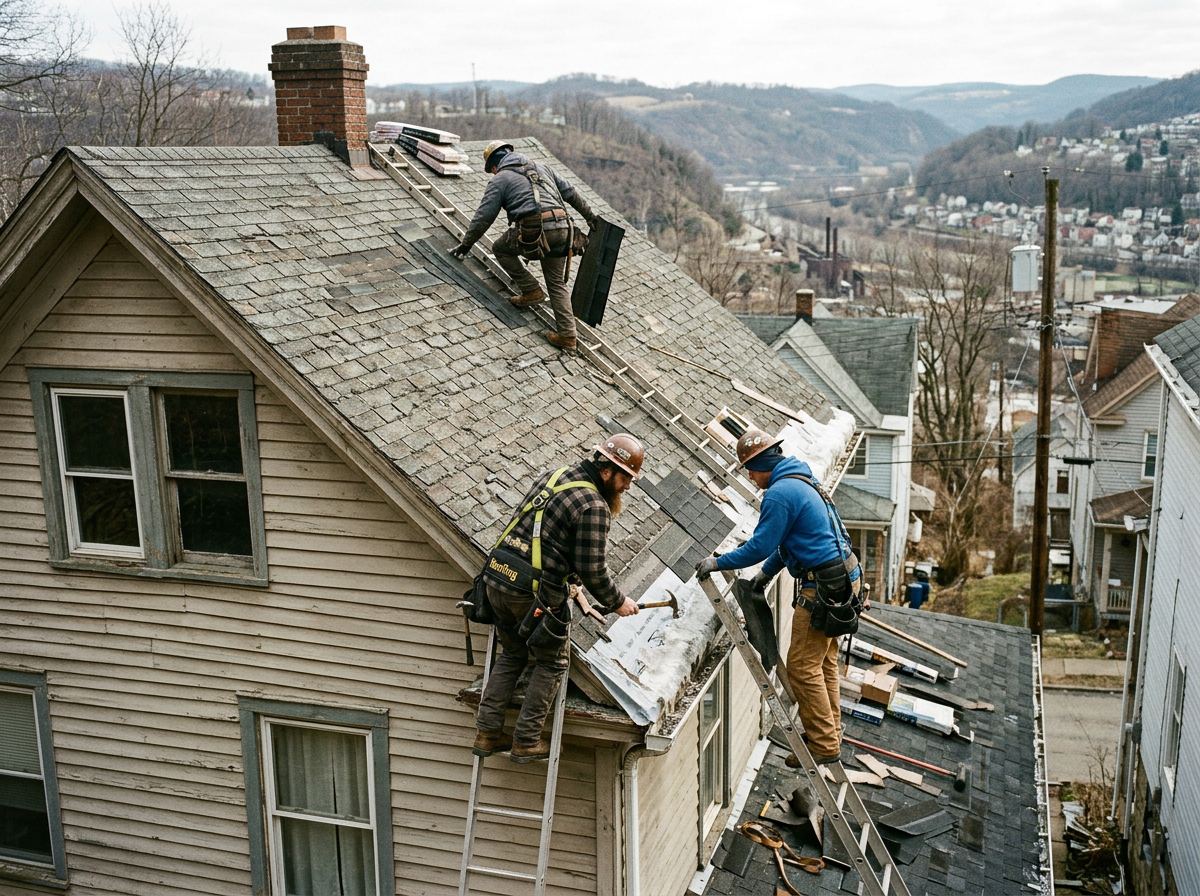
Ice dams form when warm attic air melts snow on the roof, allowing water to refreeze at the eaves and back up under shingles or slate. In Johnstown's Laurel Highlands winters, heavy snow loads combined with freeze-thaw cycles push water into plank decking on homes built between 1900 and 1940. Our crews see this repeatedly on steep-pitch roofs in Moxham, Kernville and Westmont where narrow streets and hillside lots limit equipment access. The result is often interior staining along ceilings and walls near valleys and chimneys.
We start with an attic inspection to locate moisture trails and check ventilation balance, then move to the exterior to clear dams without damaging existing slate or architectural shingles. On homes with plank decking we look for sagging or rot before deciding whether sections need re-sheathing with OSB. Flashing at chimneys, step flashing and pipe boots are examined and reset where ice has lifted them. Work is sequenced so crews can work safely on the steep grades found along PA-56 and Menoher Boulevard.
After the immediate leak path is addressed we improve intake and exhaust ventilation to reduce future heat loss that feeds ice dams. Ridge vents are added where soffit intake is adequate, and ice-and-water shield is installed along eaves and valleys during any tear-off. In Cambria City and Richland Township homes with multiple layers we remove down to the deck to eliminate hidden moisture. This approach accounts for the strong ridge winds and spring thunderstorms that follow winter in the Conemaugh River valley.
Technician insight
In Johnstown the thing that catches most people out with ice dam damage repair is plank decking on 1900-1940 homes in Westmont and Moxham. Once water sits on those boards for a few freeze-thaw cycles the rot spreads fast under the slate or old shingles, and you cannot see it from the street. Steep hillside access on narrow streets like those off Menoher Boulevard also means we have to stage materials differently than on flat Richland Township lots.
Westmont Home with Recurring Ceiling Stains
Heavy snow sat on the south-facing slope of a steep 1920s frame house in Westmont. Water backed up under the original slate at the valley and leaked through plank decking into the upstairs ceiling. We removed the dam, replaced two rotted deck boards, installed ice-and-water shield along the eaves and reset the valley flashing. No further staining occurred after the next thaw cycle.
Ice Dam Damage Repair Services We Offer
✓Ice Dam Removal and Eave Protection
Crews remove existing dams and install ice-and-water shield along eaves to stop water from backing up under shingles during Laurel Highlands freeze-thaw cycles.
✓Valley and Flashing Leak Repair
Step flashing and counter-flashing are reset or replaced where ice has displaced them on steep roofs in Westmont and Geistown.
✓Attic Ventilation Assessment
We measure soffit intake and ridge exhaust to correct unbalanced ventilation that allows attic heat to melt snow on older frame houses.
✓Plank Decking Inspection and Repair
Sagging or rotted plank decking is identified and sections are replaced with OSB before new underlayment and shingles are installed.
✓Chimney and Wall Counter-Flashing
Damaged counter-flashing around brick chimneys common on 1900-1940 homes is repaired to prevent ice-driven water entry.
How it works
- 1
Attic and Exterior Inspection
We examine insulation, ventilation and moisture trails inside the attic, then climb the roof to map ice dams and damaged flashing.
- 2
Dam Removal and Temporary Sealing
Ice is cleared carefully and temporary seals are placed at eaves and valleys to stop active leaks on steep hillside lots.
- 3
Deck and Flashing Repairs
Rotted plank decking is replaced, step flashing is reset, and ice-and-water shield is added at eaves and valleys.
- 4
Ventilation Upgrade and Final Layer
Ridge vents and soffit intake are balanced, then the roof surface is restored with matching shingles or slate-to-shingle conversion.