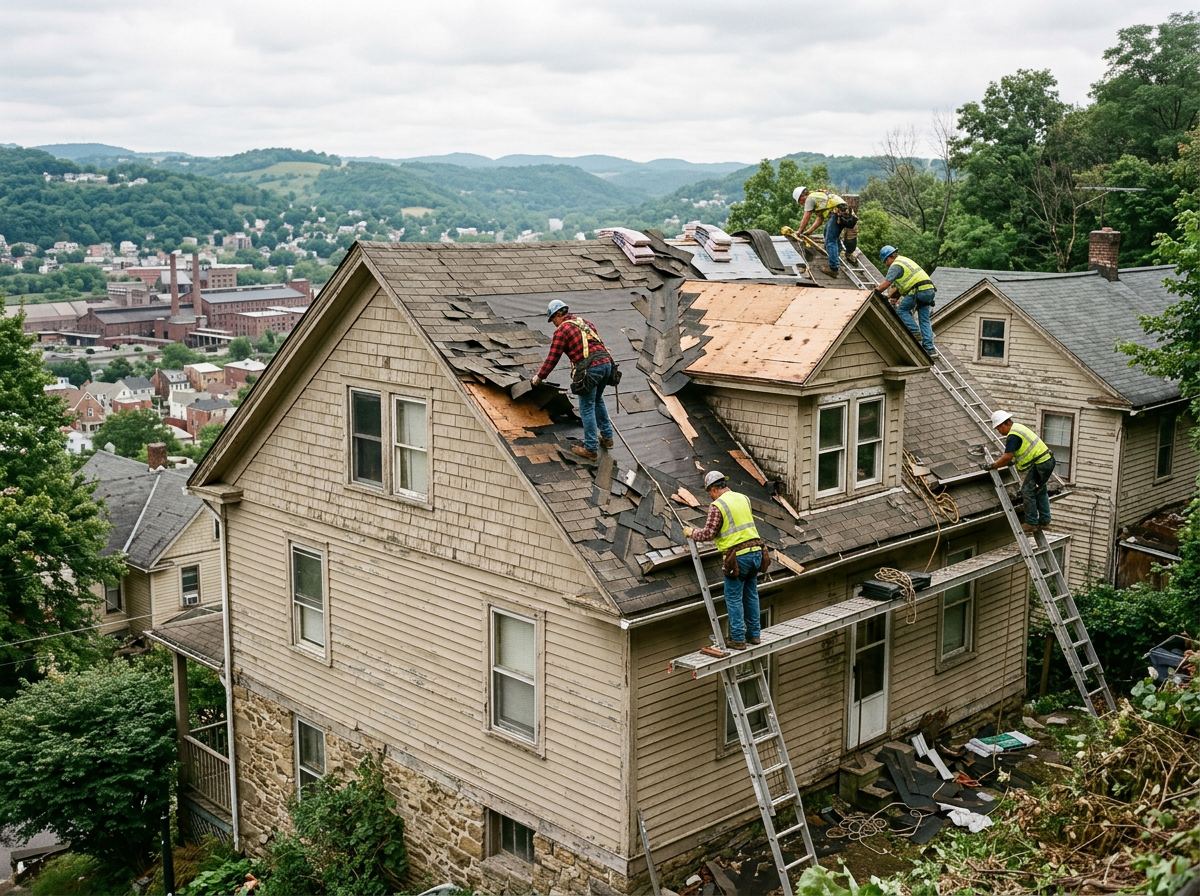
Strong winds along the Laurel Highlands ridge tops tear at steep-pitch roofs on 1900-1940 frame houses in neighborhoods such as Moxham, Kernville and Cambria City. Our crews see missing shingles, lifted step flashing around chimneys, and torn pipe boots after gusts funnel through the Conemaugh valley. Freeze-thaw cycles and prior ice dams weaken underlayment on plank decking, so even moderate wind can pull sections loose on narrow hillside streets where access is tight.
We start every job with a full top-to-bottom inspection that includes attic checks for daylight at valleys and ridge lines plus close examination of original slate under later layers. When wind has lifted architectural shingles or cracked old slate, our crews perform targeted tear-offs only where needed, re-secure plank decking with new OSB where sagging shows, and reinstall ice and water shield at eaves before laying new starter strip and ridge vent to restore attic ventilation balance.
Johnstown’s mix of brick chimneys, tight row-home lots and spring thunderstorms means wind damage often shows first at counter-flashing and soffit intakes. We match existing granule color on dimensional shingles, install new drip edge along gables, and add extra fasteners on west-facing slopes that take the strongest ridge winds. Work stays limited to the affected sections so homeowners in Westmont or Geistown avoid unnecessary disruption on the rest of the roof.
Technician insight
In Johnstown the thing that catches most people out with wind damage is how the original plank decking on 1900-1940 homes flexes under snow load after the wind has already lifted the shingles; once the deck moves, the nails back out and the next freeze-thaw cycle turns a small tear into a long leak along the valleys on those narrow Moxham and Westmont lots.
Wind-Lifted Ridge On Westmont Split-Level
High ridge winds pulled the ridge vent loose on a 1920s Westmont home, allowing water to enter along the main valley during a thunderstorm. We found daylight at three rafter bays and lifted step flashing at the chimney. Our crews replaced the damaged ridge section, re-sheeted the sagging plank deck, added new ice and water shield, and reinstalled matching architectural shingles so the roof line stayed consistent with the rest of the block.
Wind Damage Services We Offer
✓Missing Shingle Replacement
We replace individual wind-blown shingles on steep-pitch roofs, securing new architectural shingles with additional fasteners and matching the existing color and granule texture.
✓Ridge Vent and Soffit Repair
Damaged ridge vents and intake vents are replaced or reinforced so attic ventilation balance is restored after high winds pull sections loose on older Johnstown homes.
✓Chimney and Wall Flashing Repair
We re-seat step flashing and install new chimney counter-flashing where wind has lifted metal on brick chimneys common to Cambria City and Hornerstown frame houses.
✓Valley and Pipe Boot Replacement
Torn valleys and cracked pipe boots are cut out and replaced with new ice and water shield and fresh boots to stop leaks that start after wind events.
✓Deck Re-Sheathing After Wind
Where wind-driven uplift reveals sagging plank decking, we sister or replace boards and overlay with OSB before re-roofing the affected slope.
How it works
- 1
Site Inspection
Our crews walk the entire roof and attic, noting wind entry points at valleys, ridges and chimneys on the steep hillside lots typical of Johnstown.
- 2
Targeted Tear-Off
Only the wind-damaged sections are removed down to plank decking so the rest of the roof stays untouched.
- 3
Deck And Underlayment Work
Sagging areas are re-sheeted, new ice and water shield is installed at eaves and valleys, and drip edge is added along gables.
- 4
Shingle And Ventilation Restoration
Architectural shingles are laid with proper starter strip, ridge vent is reset or replaced, and soffit intakes are cleared for balanced airflow.